
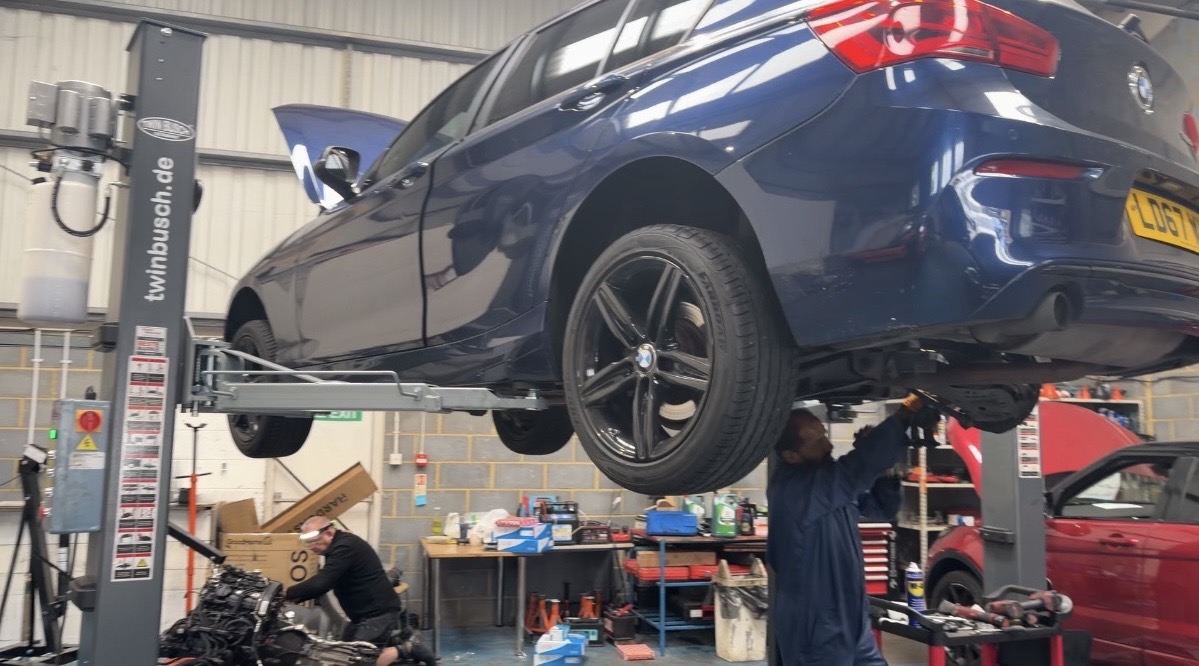
How we handle oil leak repair at Hackbridge
The search begins with a hot wash. Engine and underside are degreased on the ramp until no old oil remains, because years of coating hide a fresh source completely. A measured dose of ultraviolet dye then goes into the sump and the vehicle goes back to you for a few days of ordinary driving, since a leak that only appears at motorway temperature will never show during a five-minute idle. Under a UV lamp and amber glasses the dye reads like a map: a bright line along a cam cover edge, a halo around a filter housing O-ring, a trail from behind the timing cover.
Two checks run alongside the dye. Crankcase pressure is tested, because a blocked separator turns the inside of an engine into a pressure vessel and drives oil past seals that are otherwise sound. Replacing the gasket alone then buys a repeat visit. An inspection camera goes up the bellhousing to separate a rear crankshaft seal from a gearbox input seal without dismantling anything. You are shown the glowing source before the quote is written. What we will not do is replace a gasket on a hunch, and we will not pour in an additive to disguise the problem.
Pricing follows the source rather than the symptom. A cam cover gasket, sump plug washer or filter housing seal is quick and quoted as a fixed job. A front crankshaft seal behind a timing belt is quoted with a belt kit, because renewing the seal and leaving a belt of unknown age is a false saving. A rear crankshaft seal means the gearbox comes out, so you get a plain opinion on whether to do it now, combine it with a clutch, or watch it. Where several show up at once, they are listed in order of priority, so you can spend on the one threatening a cambelt and ignore the one that only marks the drive.